


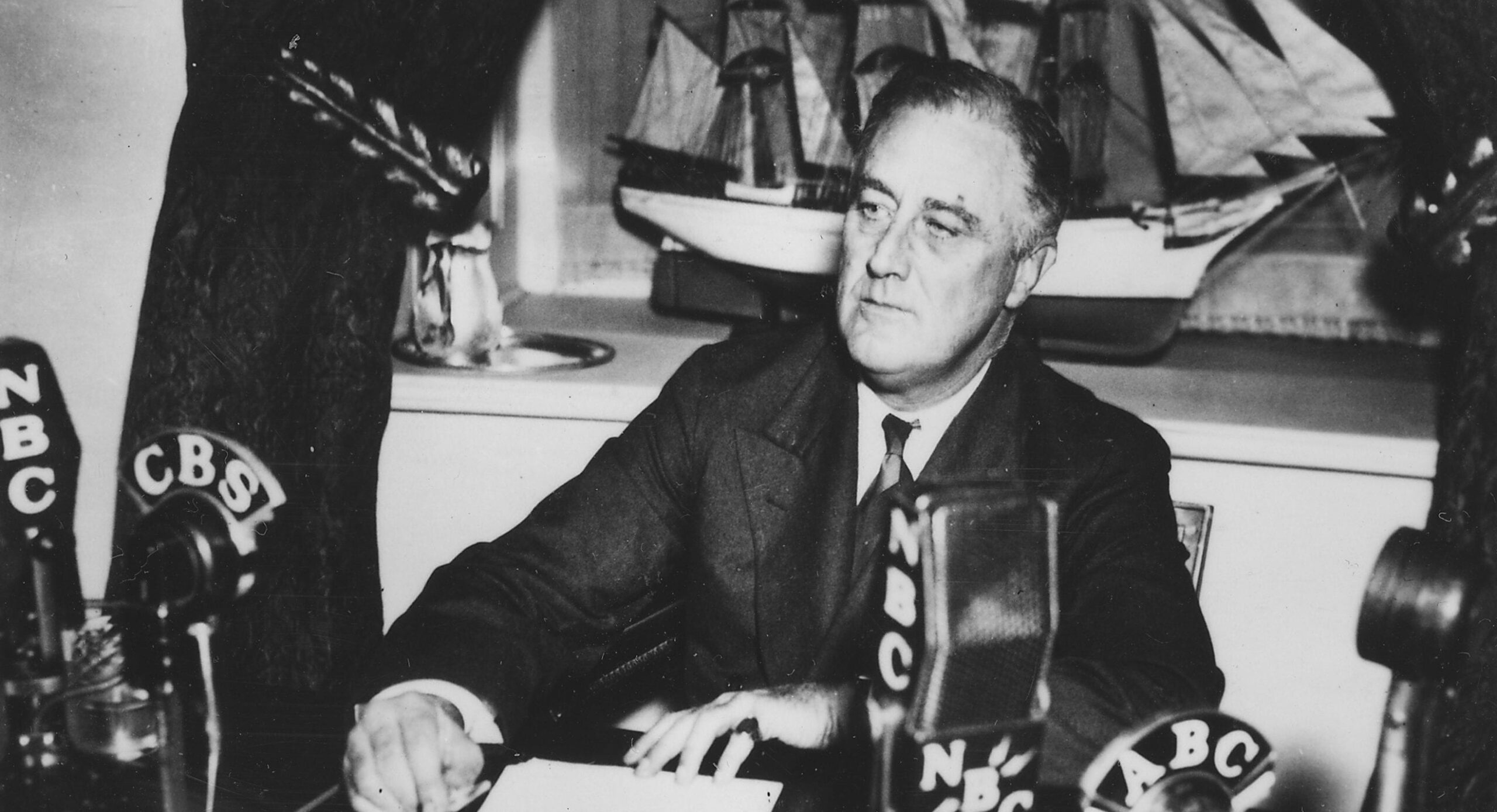
As the Ukraine-Russia War escalates with a long-awaited counteroffensive by Ukraine and news that the US will finally begin sending fighter jets as part of the Ukraine Democracy Defense Lend-Lease Act of 2022, it’s fitting and appropriate to remind ourselves of the ‘fireside chat’ Franklin Delano Roosevelt delivered on May 27, 1941, in response to the Axis powers goals of “world domination,” as he called it, when President Roosevelt announced a state of “unlimited national emergency.” His address to the nation by radio followed a formal declaration for “Military, naval, air and civilian defenses [to] be put on the basis of readiness to repel any and all acts or threats of aggression directed toward any part of the Western Hemisphere.”
The deadly facts of war compel Nations, for simple self-preservation, to make stern choices. It does not make sense, for instance, to say, “I believe in the defense of all the Western Hemisphere,” and in the next breath to say, “I will not fight for that defense until the enemy has landed on our shores.” If we believe in the independence and the integrity of the Americas, we must be willing to fight, to fight to defend them just as much as we would to fight for the safety of our own homes. It is time for us to realize that the safety of American homes even in the center of this our own country has a very definite relationship to the continued safety of homes in Nova Scotia or Trinidad or Brazil. Our national policy today, therefore, is this:
First, we shall actively resist wherever necessary, and with all our resources, every attempt by Hitler to extend his Nazi domination to the Western Hemisphere, or to threaten it. We shall actively resist his every attempt to gain control of the seas. We insist upon the vital importance of keeping Hitlerism away from any point in the world which could be used or would be used as a base of attack against the Americas.
Second, from the point of view of strict naval and military necessity, we shall give every possible assistance to Britain and to all who, with Britain, are resisting Hitlerism or its equivalent with force of arms. Our patrols are helping now to insure delivery of the needed supplies to Britain. All additional measures necessary to deliver the goods will be taken. Any and all further methods or combination of methods, which can or should be utilized, are being devised by our military and naval technicians, who, with me, will work out and put into effect such new and additional safeguards as may be needed.
– Franklin D. Roosevelt
In WWII the Axis powers were our enemies and Russia, then called the Soviet Union, was ungraciously pushed to our side after Nazi Germany invaded their former Axis ally to the East. It was decided by the Roosevelt administration that the best way to begin fighting the Nazis was to financially support Britain, Russia and France through the Lend-Lease Act and on December 29, 1940, nearly a year before the United States entered WWII, President Roosevelt delivered his famous “Arsenal of Democracy’ speech that put an end to ten years of isolationist policy that Congress shackled on the third-greatest wartime president in US history. Roosevelt was resolved to commit American might to the task at hand, and in the May 27th speech, he reminded all Americans of his most famous quote about our deepest fears:
There are some timid ones among us who say that we must preserve peace at any price—lest we lose our liberties forever. To them I say this: never in the history of the world has a Nation lost its democracy by a successful struggle to defend its democracy. We must not be defeated by the fear of the very danger which we are preparing to resist. Our freedom has shown its ability to survive war, but our freedom would never survive surrender. The only thing we have to fear is fear itself.
– Franklin D. Roosevelt
Today, we find the sons and daughters of the same weak-kneed, timid souls at the precipice of WWII unable to face the reality of a dangerous world full of enemies of democracy, no less fearsome than those that Roosevelt prepared the US for war against back in 1941. He went on to speak about the crisis in terms that we should all recognize today:
It is no mere coincidence that all the arguments put forward by these enemies of democracy—all their attempts to confuse and divide our people and to destroy public confidence in our Government—all their defeatist forebodings that Britain and democracy are already beaten—all their selfish promises that we can “do business” with Hitler—all of these are but echoes of the words that have been poured out from the Axis bureaus of propaganda. Those same words have been used before in other countries—to scare them, to divide them, to soften them up. Invariably, those same words have formed the advance guard of physical attack.
Defense today means more than merely fighting. It means morale, civilian as well as military; it means using every available resource; it means enlarging every useful plant. It means the use of a greater American common sense in discarding rumor and distorted statement. It means recognizing, for what they are, racketeers and fifth columnists, who are the incendiary bombs in this country of the moment.
– Franklin D. Roosevelt
The last two great wars fought by the US were the Vietnam War and the Korean Conflict; Iraq and Afghanistan were minor skirmishes in comparison to the efforts and expenditures in these two big wars, with the high number of casualties (over 36,000 combat deaths in Korea and 68,000 in Vietnam) to less than 6,000 combined combat deaths in both Iraq Wars and the so-called Afghanistan War. The Second World War accounted for the highest number of American combat deaths outside of the American Civil War, with a half-million American servicemen and women killed, and in both of the subsequent wars — Korea (yeah, it was technically a conflict and not a war) and the Vietnam War — these were really proxy wars fought between the US and Russia.
However when we were still awkward and unlikely allies, the US provided more than one-third of all the explosives used by Russia during the war and almost 33% of all the Red Army’s vehicles were provided through Lend-Lease. More than 20,000 Katyusha mobile multiple-rocket launchers were mounted on the chassis of Studebaker (!) trucks. The Lend-Lease program propped up the rusted and broken Soviet rail system, which was fundamental in moving and supplying troops to the front, and the program also sent nearly 2,000 locomotives and many more boxcars to Russia. In addition, almost half of all the rails used by the USSR during the war were provided by the US, and this, too, was provided for by Lend-Lease. Our aid also sent to Russia 4.5 million tons of food, 1.5 million blankets and 15 million pairs of boots. Russia (attacked by Germany on June 22, 1941 in the Barbarossa offensive) was declared eligible for Lend-Lease aid on November 7, 1941 — exactly one month before the Japanese attack on Pearl Harbor, however in retrospect, in proportion to total US defense and war expenditures in WWII, Lend-Lease was a fraction of the overall cost and it turned out that the aid amounted to only around 15% of our total financial commitment to the war, the best use of US dollars in history.
In his Arsenal of Democracy speech in 1940, Roosevelt said that, “Europe does not ask us to do their fighting. They ask us for the implements of war, the planes, the tanks, the guns, the freighters which will enable them to fight for their liberty and for our security. Emphatically we must get these weapons to them, get them to them in sufficient volume and quickly enough, so that we and our children will be saved the agony and suffering of war which others have had to endure.”
Roosevelt stressed that it was not the government but the American people who had the power to turn the tide of the war and it was in the 1940 speech that Roosevelt first used the famous phrase, the “arsenal of democracy,” saying, “We must be the great arsenal of democracy. For us this is an emergency as serious as war itself. We must apply ourselves to our task with the same resolution, the same sense of urgency, the same spirit of patriotism and sacrifice as we would show were we at war.” Finally, he reassured the American people: “I believe that the Axis powers are not going to win this war.”
After the US entered WWII, at the November 1943 Tehran Conference with British Prime Minister Winston Churchill and the General Secretary of the Communist Party of the Soviet Union Joseph Stalin, the Soviet dictator proposed executing 50,000 German officers after the conclusion of the war so that Germany could’t start another world war and it was Roosevelt, as Churchill stormed out of the meeting, with FDR believing that Stalin wasn’t being serious — this was the first time that Roosevelt and Stalin had ever met — who wittily joked that “maybe 49,000 would be enough!” The next day, the last of the momentous talks, Stalin raised a toast to the Lend-Lease program and said that, “I want to tell you what, from the Russian point of view, the president and the United States have done for victory in this war, the most important things in this war are the machines…. The United States is a country of machines. Without the machines we received through Lend-Lease, we would have lost the war.”
The cross-channel invasion of France (Operation Overlord) agreed to in Tehran would be launched in June 1944, in conjunction with operations against southern France (Operation Dragoon) and at the Tehran Conference Stalin also revealed that Russian forces would launch an offensive (Operation Bagration), that would begin two weeks after Overlord with the object of preventing German forces from transferring from the Eastern to the Western Front. Overlord was originally to begin on June 1st, 1944, but the weather, moon and tides required the invasion to be delayed until June 6th. Operations Overlord and Bagration were Roosevelt, Churchill and Stalin’s great plan to catch the Nazis off guard and to divert the Germans from their ill-fated invasion of Russia. These bold decisions would eventually spell the beginning of the end of Adolf Hitler and the Nazi regime.
Carl Holt
May 27, 2023
 Wednesday